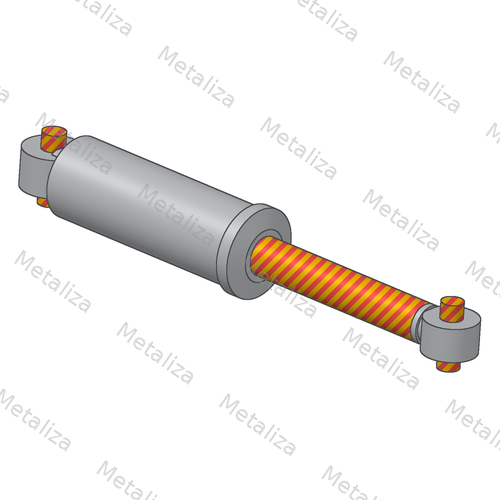
- Service life:
- Repair of a used part: the performance of a thermal-sprayed part versus an original one ranges from similar (using a very basic coating material, or one equivalent to the part's original material) up to 2–10 times the service life, by applying high-performance engineering materials. Use in manufacturing: when a particular material is specified based on mechanical–chemical behavior, the component's service life is only possible if the coating is applied.
- Wear agent:
- Sliding of one surface over another, with wear further accelerated by airborne dust particles, impurities in lubricants, contaminants in fluids, etc.
- Attack effect:
- Increased roughness. As the phenomenon begins, friction coefficients rise, facilitating the abrasive effect and causing a cascading feedback that increases wear until deformation and grooves of varying depth become visible.
- Layer description:
- Geometrically restores the components, making them reusable. In many cases, when a packing zone separates an area with corrosive agents from an inert area, the material must be chosen according to its mechanical and chemical resistance.
- Layer application:
- When deformation occurs in service. During the design stage it is determined that a material better suited to this function be added during the part's manufacture.
- Material type:
- Steel-type metal alloys. High-chromium metal alloys. Nickel-base alloys. Cobalt-base alloys. White metal. Ceramic materials. Carbides.
- Typical location:
- Bearing working areas. Linear displacements.